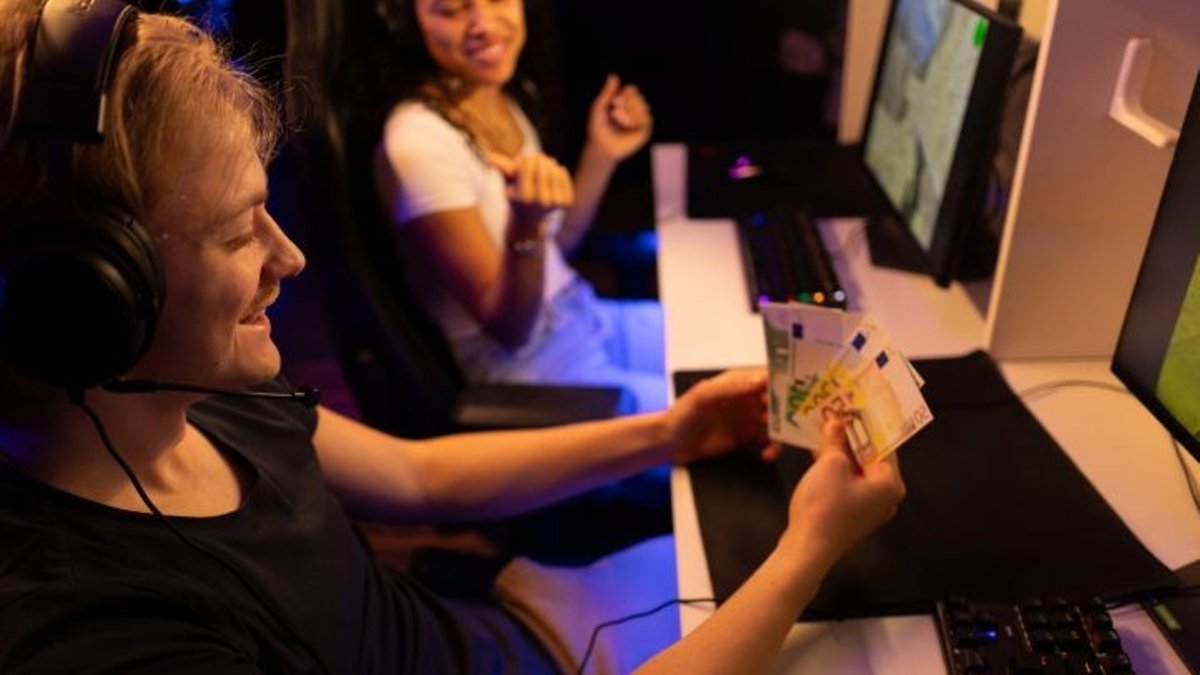
A law professor has proposed federal legislation to regulate in-game currency, arguing that the video game industry has developed unregulated monetary systems that produce financial harm.
In a recent article, Raúl Carrillo highlights how companies like Sony issue “gaming money”—points earned in play, gift cards, and platform-stored balances—that increasingly convert into bank deposits. These instruments, Carrillo explains, adopt features of banking money but evade existing regulatory categories.
What is gaming money?
Carrillo identifies several forms of gaming money. “Play money” is earned or purchased within games, reducing friction by allowing gamers to buy items without entering credit card details. It can also be exchanged for traditional currency on third-party marketplaces. “Store money” refers to instruments held in digital wallets, while gift cards act as vouchers, transferring value between the gaming industry and the broader economy.
These systems fit into a broader history of “shadow money”—financial instruments issued by nonbank corporations that serve monetary functions without government regulation.
Historical Context of Shadow Money
During the early 20th century, railroad and coal companies issued scrip, a form of currency tied to their own accounting units, despite the nationalized financial system. Although the Fair Labor Standards Act of 1938 banned scrip, it persisted in new forms, such as gaming money. Carrillo argues that statutory conflicts and lenient interpretations by agencies and courts enable nonbank companies to create financial instruments resembling money.
Gaming platforms have become avenues for money laundering, where fraudsters use stolen credentials to buy in-game items and obscure funds’ origins. These virtual currencies can be converted into real monetary currency, like cryptocurrency or cash. Carrillo highlights that this convertibility exposes gamers and developers to payments and liquidity risks, with Roblox reporting significant virtual currency sales, illustrating the scale of these liabilities.
The risks of unregulated gaming money
Carrillo argues that shadow money contributes to rate manipulation, money laundering, and financial instability because nonbank companies can evade traditional regulation. Gaming companies manipulate rates by blurring the psychological line between virtual currency and real currency, according to Carrillo. They further exploit consumer confusion through confusing exchange rates, bundled virtual currencies, and algorithmic pricing based on undisclosed personal data.
For instance, Roblox reported $6.79 billion in virtual currency sales in fiscal year 2025. However, many companies do not disclose these sales or bury them in deferred revenue categories. This lack of transparency means consumers may not be entitled to repayment if funds are trapped on platforms.
Carrillo rejects the gaming industry’s claim that its products exist in a “virtual world” beyond regulation. He points to a federal court decision that deemed Roblox’s virtual currency, Robux, a “thing of value” due to its convertibility into cash. This highlights the real-world impact of gaming money, necessitating regulatory oversight.
To address these issues, Carrillo proposes a federal Gaming Money Act, which would set standards for exchange rates, including fixing rates for periods and mandating user protections, and require companies to verify the identities of adult gamers who exchange gaming money. It would also separate gaming money activities from broader corporate balance sheets.
In the United States, while the Consumer Financial Protection Bureau expressed concern in 2024, it has not adopted a structural framework, leaving states like California to take the lead with laws like the Digital Financial Assets Law.
Carrillo concludes that federal agencies should supervise companies that convert gaming money to traditional money. The gaming companies’ ability to evade regulation through in-game currency shows that the regulatory system has not kept pace with the technological evolution of shadow money.
The Role of Convertibility in Regulatory Oversight
Carrillo emphasizes that “convertibility”, the ability to exchange gaming money for traditional currency and bank deposits, should determine the extent of regulatory oversight. He argues that when gaming companies provide mechanisms to convert virtual currency into real-world value, they enter the domain of monetary authority, requiring regulation.
International and State-Level Efforts
This gap has led states like California to take action. However, the law excludes value “issued and usable only within an online game platform,” potentially leaving some in-game currencies unregulated.


