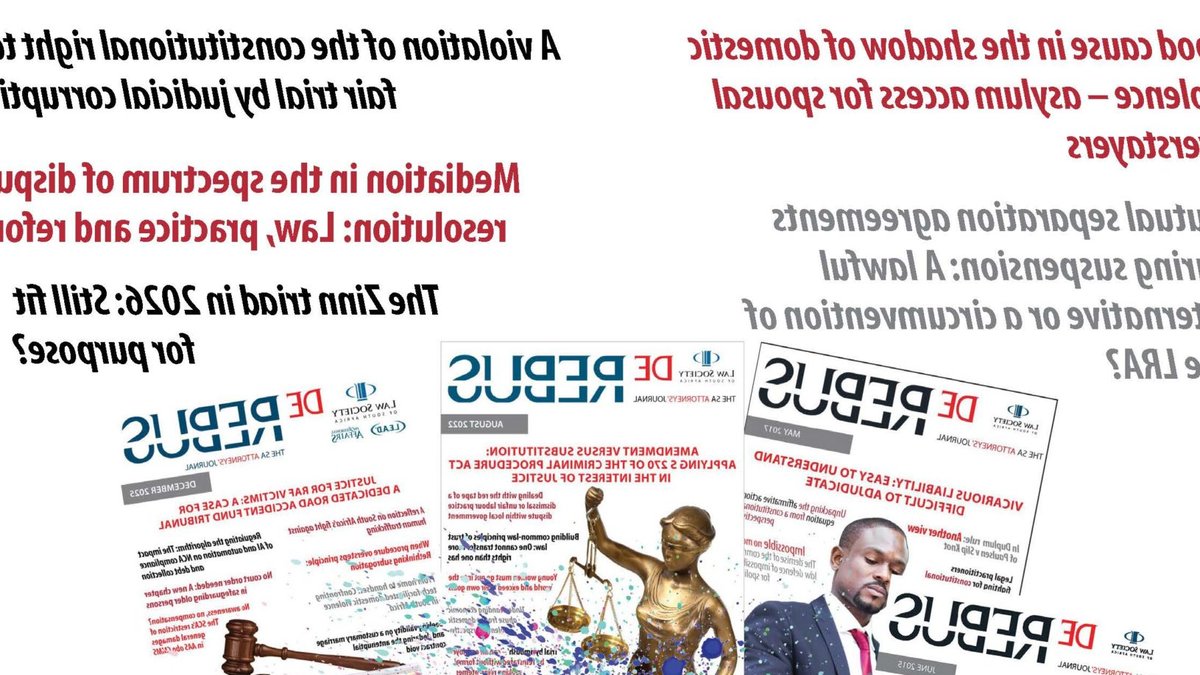
De Rebus turns 70 this September, marking seven decades as a cornerstone of South Africa’s legal profession. The journal’s longevity reflects not just its own evolution, but the profession’s transformation—from a provincial focus to a national platform, from print to digital, and from a niche publication to a widely consulted resource.
The first issue appeared in 1956 as De Rebus Procuratoriis, published by the then Incorporated Law Society of the Transvaal. Its inaugural editorial framed it as more than a monthly update: it was designed to inform members about professional matters, track legal developments, and offer a space for debate. This dual role—practical guidance and professional dialogue, has remained central.
By 1968, the journal had expanded beyond its Transvaal origins. The Association of Law Societies (now the Law Society of South Africa) took over publication, shifting De Rebus from a regional to a national attorneys’ journal. The move mirrored broader changes in South Africa’s legal environment, as the profession grew more interconnected.
Digital expansion reshapes accessibility
Coverage evolved alongside these shifts. In the mid-1980s, the journal began reflecting a more inclusive profession and the country’s broader social changes. By 1998, the LSSA became its publisher, and in the same decade, De Rebus launched a free online archive. The move to digital in 2019, ending free print distribution, was driven by rising costs, but it also expanded reach. Today, its website, newsletters, and social media extend its audience far beyond traditional subscribers.
The journal’s physical format has also adapted. It started as an A5 publication before switching to A4 in 1978, creating more space for articles. Desktop publishing in the 1990s streamlined production, bringing design and typesetting in-house. These changes were incremental but critical: each reflected the profession’s needs and the tools available at the time.
Behind the scenes, the journal’s survival depends on its people. The Editorial Committee and staff curate content, ensuring relevance through careful selection and editing. Contributors, legal practitioners, academics, and experts, drive the conversation, while readers sustain engagement. Advertisers, too, have played a role since 1956, funding the publication’s operations.
What hasn’t changed is the core mission. From its first issue, De Rebus aimed to inform, connect, and shape the profession. As technology and the legal environment have shifted, the journal has stayed true to that purpose. The shift to digital didn’t alter its role; it simply made it more accessible. The same holds for its expanding coverage: inclusivity was always part of its mandate, even if it took decades to fully realize.
Archives reveal profession’s evolving challenges
Yet the profession itself has transformed. In 1956, South Africa’s legal system was far different from today’s. The journal’s archives now document those changes, from apartheid-era restrictions to post-apartheid reforms, from paper-based research to digital case law. Each issue, whether in print or online, has captured a moment in the profession’s history.
The next 70 years will likely bring further changes. The journal’s future hinges on the same factors that have sustained it: contributors willing to share expertise, readers engaged with its content, and supporters investing in its continuity. As the LSSA notes, the work of producing each issue remains labor-intensive, selecting submissions, editing rigorously, and ensuring practical relevance. Without that effort, the journal risks losing its edge.
For now, De Rebus stands as a sign of endurance. It has outlasted formats, political eras, and technological revolutions. Its 70th anniversary isn’t just a milestone; it’s a reminder of how a single publication can mirror, and help shape, a profession’s trajectory.


